/ European Union
Overview
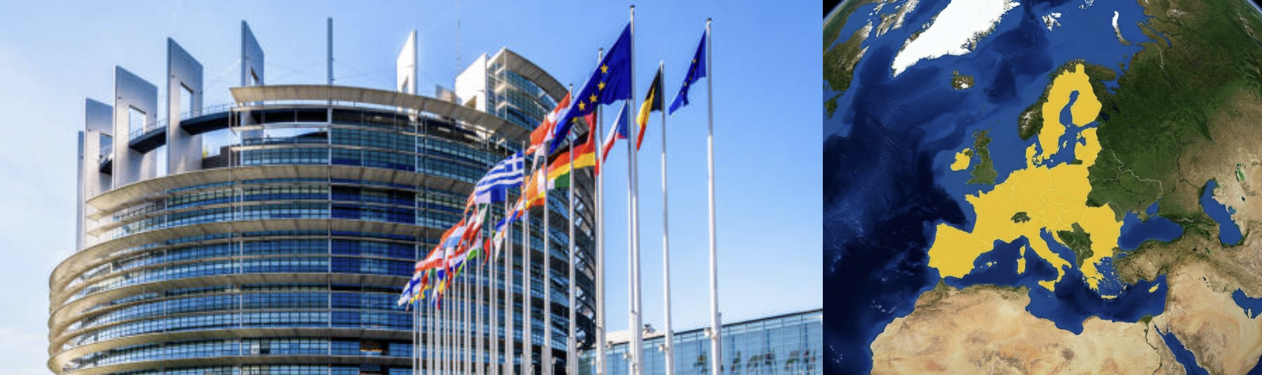
The European Union (EU) is a supranational political and economic union of 27 member states located primarily in Europe. It is bounded by the Atlantic Ocean to the west, the Arctic Ocean to the north, and the Mediterranean Sea to the south, while sharing land borders with non-EU neighbors such as the United Kingdom, Norway, Switzerland, and several Balkan and Eastern European nations. The EU covers a total land area of approximately 4.23 million square kilometers and has an estimated population of 453.3 million as of February 2026. The union operates through a system of supranational independent institutions and intergovernmental-negotiated decisions, including the European Commission, the European Parliament, and the European Council.












In 2025, the GDP reached approximately US$21.1 trillion (nominal), and per capita GDP was US$46,804. The EU economy is predominantly driven by the service sector, which accounts for c.73.1% of its GDP, including finance, logistics, and high-tech services. Private consumption and intra-EU trade are the primary drivers of economic growth. The union is a massive global trade bloc, operating as a single market with a common commercial policy. Its largest trading partners are the United States, China, the United Kingdom, Switzerland, and Türkiye. The EU is a world leader in the export of manufactured goods, particularly machinery and vehicles, chemicals, and pharmaceuticals; it also produces significant high-value agricultural products. The transition to a "Green Deal" economy and digital sovereignty are expected to be major future growth drivers. Additionally, the tourism sector remains a vital economic pillar, contributing c.10.5% to the GDP in 2025, with Europe remaining the world's most visited region. The industrial sector represents approximately 21.9% of the GDP and employs about 23.5% of the workforce, while the agricultural sector accounts for c.1.6% of GDP. Imports of energy products (crude oil and natural gas), electronic components, and raw materials are among the highest for the union, with top import partners being China, the United States, Norway, and the United Kingdom.
The European Union has its roots in the aftermath of World War II, beginning with the European Coal and Steel Community in 1951 to ensure lasting peace. Following decades of integration through treaties such as the Treaty of Rome (1957) and the Maastricht Treaty (1992), it evolved into its current form with a common currency, the Euro, used by 20 of its member states. Since its inception, the EU has expanded significantly, fostering democratic stability and creating one of the world's largest and most integrated economic spaces, consistently working toward a "more perfect union" through shared values of human rights and the rule of law.